When people search for the richest countries in Africa, they often imagine a simple ranking based on money, skyscrapers, or oil wealth. In economics, however, the word richest countries in Africa has a more precise meaning. It depends on how wealth is measured. A country may have a huge economy in total size, yet millions of citizens still face low incomes. Another country may have a much smaller economy, but a higher standard of living for the average resident.
This is why economists usually use two key indicators when discussing the richest countries in Africa. The first is Nominal GDP, which measures the total size of an economy in current US dollars. The second is GDP per Capita (PPP), which measures average income adjusted for local prices and purchasing power. One tells us who has scale and strategic weight. The other tells us where prosperity is more visible at household level.
Understanding this difference changes how we read Africa’s economic map. It also explains why countries such as Nigeria and South Africa dominate one ranking, while Seychelles and Mauritius lead another.
Key Takeaways
Why “Richest” Is Often Misunderstood?
Imagine two households. One family earns $10,000 a month but supports ten people. Another earns $5,000 but supports two people. Which family is richer? The answer depends on whether we focus on total income or income per person.
Countries work in much the same way.
A populous nation like Nigeria can generate enormous national output because it has over 200 million people, vast resources, and large domestic demand. But when that output is divided across a very large population, per-person income may appear lower. By contrast, Seychelles has a tiny population, so its tourism income and services revenue translate into a much higher figure per resident.
This is why one headline can say Nigeria is among Africa’s biggest economies, while another says Seychelles is among the richest countries in Africa. Both can be true.

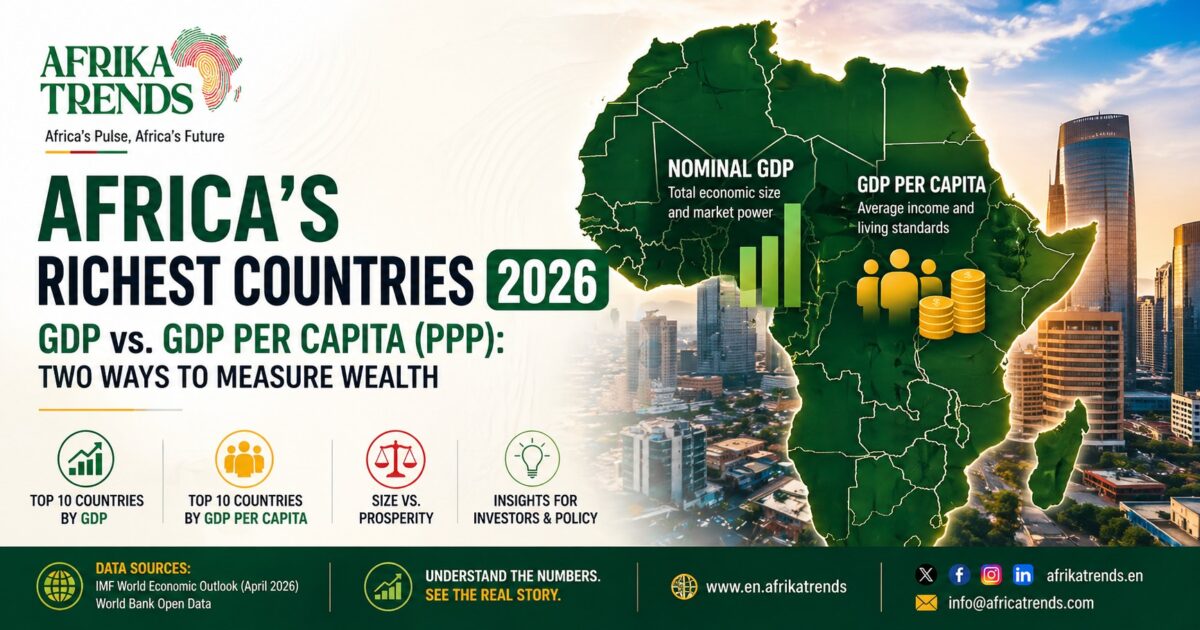
Comparative infographic showing the top 10 African economies by nominal GDP and GDP per capita (PPP), highlighting how market size and average prosperity produce different rankings across the continent.
Top 10 Richest Countries in Africa by Nominal GDP (Economic Size)
Nominal GDP reflects total production, market scale, state capacity, and regional influence. It matters for investors, manufacturers, and global trade partners.
| Rank | Country | GDP (2026 Est.) | Core Growth Engines |
| 1 | South Africa | $479.96B | Finance, mining, manufacturing |
| 2 | Egypt | $429.64B | Suez Canal, tourism, gas |
| 3 | Nigeria | $377.37B | Oil, telecom, agriculture |
| 4 | Algeria | $317.17B | Oil and natural gas |
| 5 | Morocco | $194.33B | Tourism, industry, phosphates |
| 6 | Angola | $152.35B | Oil, diamonds |
| 7 | Kenya | $147.26B | Technology, finance, agriculture |
| 8 | Democratic Republic of the Congo | $123.41B | Copper, cobalt |
| 9 | Ethiopia | $121.53B | Infrastructure, agriculture |
| 10 | Ghana | $118.29B | Gold, cocoa, oil |
This ranking shows who carries continental weight. South Africa remains the most diversified economy, with deep capital markets and industrial capacity. Egypt benefits from geography and the strategic Suez Canal, one of the world’s most important shipping arteries. Nigeria, despite currency pressure, remains one of the most commercially dynamic markets in Africa.
If a global company wants to sell telecom services, food products, or construction materials, this list matters more than per-capita rankings.
Top 10 Richest Countries in Africa by GDP per Capita (PPP)
GDP per Capita (PPP) focuses on average purchasing power and living standards. It often reveals a different group of leaders.
| Rank | Country | GDP per Capita (PPP) |
| 1 | Seychelles | $42,110 |
| 2 | Mauritius | $33,023 |
| 3 | Libya | $25,847 |
| 4 | Gabon | $24,739 |
| 5 | Egypt | $21,759 |
| 6 | Equatorial Guinea | $20,494 |
| 7 | Botswana | $19,053 |
| 8 | Algeria | $18,509 |
| 9 | South Africa | $16,050 |
| 10 | Tunisia | $14,983 |
This ranking highlights a different development model. Mauritius built a services economy based on tourism, logistics, and finance. Botswana converted diamond wealth into relatively stable institutions and middle-income progress. Seychelles uses premium tourism rather than mass industry.
If a business is selling luxury hospitality, wealth management, or premium real estate, this ranking becomes more relevant.
Why Nigeria Is Big but Not Rich Per Person?
This is one of the most common questions. Nigeria has one of Africa’s largest economies because of its population, entrepreneurship, natural resources, and market depth. But it also has a very large population, so output is spread across many households.
Think of a large pizza shared by twenty people versus a smaller pizza shared by four. The total pizza may be bigger, but each slice can be smaller. This is why economists separate economic scale from individual prosperity.
A Real-Life Investor Example
Suppose two companies want to expand into Africa.
A supermarket chain may prefer Nigeria, Egypt, or Kenya because they offer population size and strong consumer volumes.
A luxury resort brand may look first at Mauritius or Seychelles because spending power per resident and tourism demand are higher.
Both strategies are rational. They simply use different indicators.
Richest Countries in Africa and the Resource Trap
Some countries rank highly because of oil, gas, or minerals. Libya, Gabon, and Equatorial Guinea are examples where resource income lifts per-capita numbers.
But economists often ask a second question: Is that wealth broad-based?
If income stays concentrated in one sector or one elite group, headline wealth may not fully reflect daily living conditions. This is why GDP data should always be read alongside employment, inflation, inequality, and governance quality.
What to Watch in 2026 and Beyond
The future list of richest countries in Africa may change as countries invest in manufacturing, digital finance, logistics, renewable energy, and trade integration under the African Continental Free Trade Area.
Countries such as Kenya, Morocco, Egypt, and Ghana are positioning themselves through industrial policy and regional connectivity. That could matter more over time than simple oil wealth.
Conclusion
The question of who the richest countries in Africa are does not have a single answer, because economic wealth can be measured in more than one way. If the focus is on the largest economies, then countries such as South Africa, Egypt, Nigeria, and Algeria remain the continent’s principal economic powers due to their market size, production capacity, and regional influence. If the focus shifts to average wealth per citizen, then Seychelles, Mauritius, Libya, and Botswana emerge more strongly because of higher purchasing power and income levels relative to population size.
What this reveals is that Africa’s economic landscape is far more complex than a simple ranking table. Large economies often benefit from scale, labour force depth, and strategic importance, while smaller high-income states may perform better in terms of living standards and per-person income. Neither measure alone tells the full story. The more important question for the coming decade is which countries can transform economic resources, demographic growth, and geographic advantages into broad-based prosperity.
Ultimately, the future leaders of Africa may not be those currently at the top of either list, but those that succeed in building productive industries, resilient institutions, skilled populations, and inclusive growth models capable of converting wealth into lasting development.